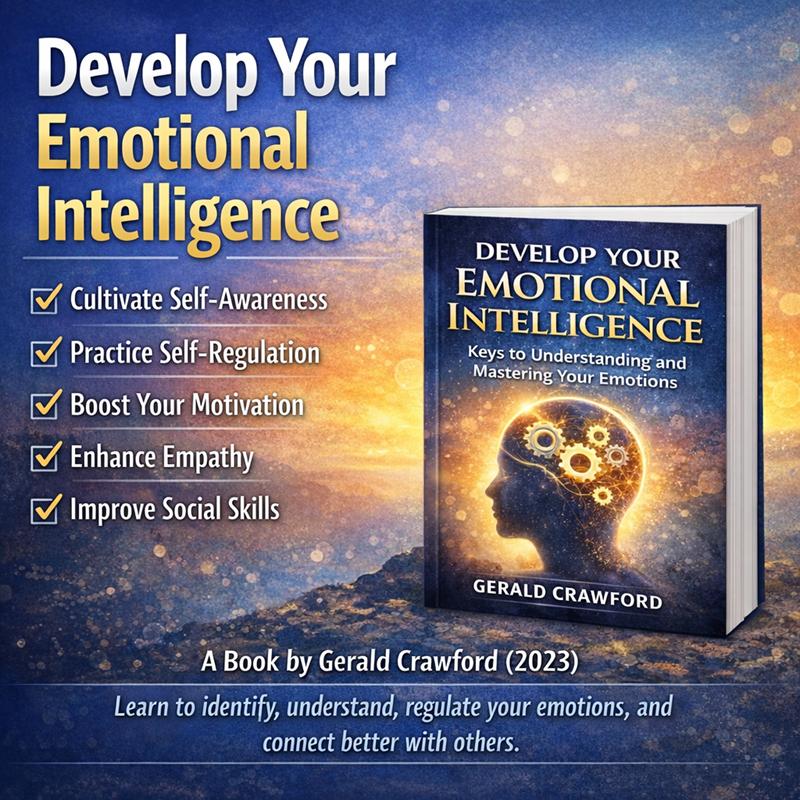
To develop Emotional Intelligence (EI), cultivate self-awareness by identifying and naming your emotions, self-regulation by managing those feelings, motivation by setting goals, empathy by understanding others' perspectives, and improving social skills through active listening and clear communication.

Category: 111 Development your Emotional Intelligence (Page 4 of 7)

Case Study 22: Developing Emotional Intelligence and healing from Apathy (50): Giving up on life, hopelessness.

Case Study 22: Developing Emotional Intelligence and Healing from Apathy

Consciousness Level: Apathy (50)
Emotional State: Giving up on life, hopelessness


Background

Joseph (46) once described himself as “tired in a way sleep doesn’t fix.”
He was employed, physically healthy, and socially functional — yet emotionally disengaged from life. Nothing felt meaningful. Goals that once motivated him now felt pointless. He wasn’t actively depressed in a dramatic sense; he had simply stopped expecting life to improve.

Joseph had experienced years of quiet disappointments: career stagnation, the end of a long-term relationship, and repeated efforts that led nowhere. Over time, hope eroded. What remained was emotional shutdown.


Emotional Landscape at the Level of Apathy

At the Apathy level, the core belief is:
“Nothing I do will make a difference.”

Joseph’s emotional world was characterised by:

  • Emotional numbness

  • Low energy and motivation

  • Withdrawal from meaningful engagement

  • A sense of futility rather than sadness

Unlike grief, which feels heavy, apathy feels empty.


Impact on Relationships

Apathy reshaped Joseph’s relationships by removing emotional presence:

  • Those He Loved and Cared For:
    He became distant, not out of anger, but exhaustion. Loved ones felt shut out.

  • Those He Needed:
    He stopped advocating for himself, accepting poor treatment passively.

  • Those He Tolerated or Felt Indifferent To:
    He drifted into social invisibility, neither engaging nor resisting.

Apathy flattened relational dynamics — there was no conflict, but no connection either.


Behavioural Patterns

Joseph’s behaviours reflected emotional surrender:

  • Procrastination without anxiety

  • Neglect of long-term goals

  • Passive acceptance of unsatisfying situations

  • Minimal emotional expression

These behaviours were often misinterpreted as laziness, when in fact they signalled emotional depletion.


The Turning Point: Reintroducing Choice

Healing from apathy did not begin with passion or optimism.
It began with choice.

In therapy, Joseph was asked a deceptively simple question:

“What is one small action you could take today that contradicts giving up?”

This reframed life from an overwhelming burden to a series of manageable moments.


Developing Emotional Intelligence

Joseph rebuilt EI through three foundational steps:


1. Emotional Reconnection

Rather than forcing motivation, he focused on feeling anything:

  • Walking daily without goals

  • Listening to music mindfully

  • Naming bodily sensations

This gently reawakened emotional awareness.


2. Agency Restoration

Joseph practiced making small, deliberate choices:

  • Choosing when to engage

  • Choosing when to rest

  • Choosing what to tolerate

Each choice, however minor, weakened the belief that he was powerless.


3. Meaning Through Action

Meaning followed action — not the other way around.
Joseph committed to simple routines:

  • Regular meals

  • Light physical movement

  • Structured days

Consistency restored trust in himself.


Movement Up the Consciousness Scale

Joseph’s progression was subtle but transformative:

  • From Apathy (50) → emotional reconnection

  • To Grief (75) → allowing sadness and loss

  • Toward Courage (200) → reclaiming responsibility and engagement

Apathy lifted not through inspiration, but through participation.


Outcome

Over time, Joseph experienced:

  • Gradual return of emotional responsiveness

  • Renewed interest in life’s small details

  • Stronger relational presence

  • A growing sense of purpose

Hope did not arrive suddenly — it emerged quietly as he re-entered life.


Key Learning

Apathy is not the absence of feeling — it is the absence of hope.
It heals when people experience agency, choice, and incremental success.

Emotional intelligence restores life by teaching people that engagement precedes meaning.
Case Study 21: Developing Emotional Intelligence and healing from Guilt (30): Remorse, self-judgment.

Case Study 21: Developing Emotional Intelligence and Healing from Guilt

Consciousness Level: Guilt (30)
Emotional State: Remorse, self-judgment


Background

Naledi (38) is a dedicated professional and mother who is widely seen as responsible and caring. Yet internally, she carries a persistent sense of having failed — as a partner, a parent, and a person. Unlike shame, which attacks identity, Naledi’s emotional struggle focuses on actions she believes she “should have done differently.”

Her upbringing emphasised moral correctness and duty. Mistakes were not met with punishment, but with disappointment. Over time, Naledi learned that being “good” meant never letting anyone down. When she did, guilt quickly filled the space.


Emotional Landscape at the Level of Guilt

At the Guilt level, the dominant belief is:
“I did something wrong.”

Naledi’s emotional world was marked by:

  • Persistent self-blame

  • Rumination over past decisions

  • Difficulty forgiving herself

  • A sense of owing others emotional repayment

Unlike shame, guilt still allows a sense of self — but it is heavily burdened.


Impact on Relationships

Guilt shaped Naledi’s relationships in subtle but powerful ways:

  • Those She Loved and Cared For:
    She over-compensated, often sacrificing her own needs to “make up” for perceived failures.

  • Those She Needed:
    She feared disappointing authority figures and avoided honest conversations.

  • Those She Tolerated or Felt Indifferent To:
    She took responsibility for emotions that were not hers to carry.

Guilt blurred boundaries, turning care into obligation.


Behavioural Patterns

Naledi’s behaviour was driven by an internal moral accountant that never balanced:

  • Excessive apologising

  • Difficulty saying no

  • Over-functioning in relationships

  • Avoidance of situations that might trigger criticism

While these behaviours appeared selfless, they quietly drained her emotional energy.


The Turning Point: Responsibility Without Punishment

Naledi’s growth began when she learned that responsibility does not require self-punishment.

Through coaching, she was introduced to a key EI distinction:

Responsibility asks, “What can I do now?”
Guilt asks, “How bad should I feel?”

This insight marked the beginning of emotional maturity.


Developing Emotional Intelligence

Naledi strengthened her EI through three core practices:


1. Emotional Differentiation

She learned to distinguish:

  • Healthy remorse (signals values)

  • Unhealthy guilt (endless self-judgment)

This allowed her to respond constructively instead of looping in regret.


2. Self-Forgiveness

Naledi practiced acknowledging mistakes once, then releasing them:

  • “I see what happened.”

  • “I accept my humanity.”

  • “I choose to move forward.”

Forgiveness became an act of responsibility, not indulgence.


3. Boundary Awareness

She learned that:

  • Saying no is not wrongdoing

  • Disappointing others is not moral failure

  • Adults manage their own emotions

This shifted her from over-giving to balanced relating.


Movement Up the Consciousness Scale

Naledi’s emotional development followed a natural progression:

  • From Guilt (30) → conscious accountability

  • To Courage (200) → self-trust and honest action

  • Toward Acceptance (350) → emotional responsibility without blame

The key shift was from judging the past to choosing the present.


Outcome

Over time, Naledi experienced:

  • Reduced emotional fatigue

  • Greater self-respect

  • Clearer boundaries in relationships

  • A calmer internal dialogue

She remained conscientious — but no longer self-punishing.


Key Learning

Guilt becomes toxic when it outlives its usefulness.
Its healthy role is to guide correction — not to define identity.

Emotional intelligence transforms guilt into learning, repair, and forward movement.

Case Study 20: Developing Emotional Intelligence and healing from Shame (20): Destructive, self-loathing.

Case Study 20: Developing Emotional Intelligence and Healing from Shame

Consciousness Level: Shame (20)
Emotional State: Destructive, self-loathing


Background

Thabo (42) is a mid-level manager who outwardly appears competent and reliable. Internally, however, he lives with a constant sense of unworthiness. He believes that if people truly knew him, they would reject him. This belief has shaped his relationships, career choices, and emotional life for decades.

Thabo grew up in an environment where affection was conditional and mistakes were met with humiliation rather than correction. Praise was rare; criticism was public. Over time, he internalised the message:
“I am fundamentally flawed.”

This belief did not operate consciously — it lived beneath his thoughts, quietly directing his behaviour.


Emotional Landscape at the Level of Shame

At the Shame level, emotions are not just painful — they are identity-defining.

Thabo’s dominant internal experiences included:

  • Chronic self-criticism

  • Persistent feelings of inferiority

  • Fear of being exposed or “found out”

  • Emotional withdrawal and isolation

Rather than thinking “I made a mistake,” he thought:
“I am a mistake.”

This distinction is central to understanding shame.


Impact on Relationships

Thabo’s shame influenced how he related to others across all relationship levels:

  • Those He Loved and Cared For:
    He struggled to receive love, often mistrusting affection or sabotaging closeness.

  • Those He Needed:
    He over-relied on approval from authority figures, tying his worth to performance.

  • Those He Tolerated or Felt Indifferent To:
    He perceived neutral interactions as rejection or judgment, reinforcing his self-loathing.

Shame distorted reality — neutral events felt personal, and minor feedback felt devastating.


Behavioural Patterns

From the outside, Thabo appeared quiet and agreeable. Internally, he was in constant emotional distress.

Common behaviours included:

  • Avoiding conflict at all costs

  • People-pleasing and over-apologising

  • Procrastination driven by fear of failure

  • Self-sabotage when success felt undeserved

These behaviours temporarily reduced anxiety but reinforced shame long-term.


Turning Point: Awareness Without Judgment

Healing did not begin with confidence — it began with awareness.

Through counselling, Thabo learned to:

  • Name shame as an emotional state, not a truth

  • Separate identity from behaviour

  • Recognise the inner voice of self-attack as learned, not factual

This marked the first step in developing emotional intelligence:

“I am feeling shame”
instead of
“I am shameful.”

This shift alone reduced the intensity of his emotional suffering.


Developing Emotional Intelligence

Thabo focused on three core EI skills:

1. Emotional Recognition

He learned to identify shame in his body:

  • Tight chest

  • Avoidant eye contact

  • Urge to withdraw

Recognising the emotion early prevented spirals of self-destruction.


2. Emotional Regulation

Rather than suppressing shame, he practiced:

  • Self-compassionate language

  • Grounding techniques

  • Allowing emotions without acting on them

This softened the internal attack cycle.


3. Cognitive Reframing

He challenged automatic thoughts such as:

  • “I’m not good enough”

  • “I don’t belong”

Replacing them with neutral truths:

  • “I am learning.”

  • “I made an error, not a moral failure.”

This slowly moved him toward Guilt (30) — a healthier level where responsibility replaces identity collapse.


Movement Up the Consciousness Scale

Progress was gradual but real:

  • From Shame (20) → awareness and naming

  • To Guilt (30) → recognising behaviour without self-destruction

  • Toward Courage (200) → taking responsibility without self-hatred

The key was self-compassion, not self-improvement.


Outcome

After sustained effort, Thabo experienced:

  • Increased emotional resilience

  • Healthier boundaries in relationships

  • Reduced fear of judgment

  • A growing sense of self-worth independent of performance

Shame no longer defined him — it became an emotion he could recognise, tolerate, and release.


Key Learning

Shame is not healed by success, approval, or perfection.
It is healed through awareness, compassion, and emotional literacy.

When people learn to observe shame rather than identify with it, they reclaim choice, agency, and dignity.

Case Study 31: Developing Emotional Intelligence building Reason (400): Understanding, logic.

Case Study 31: Developing Emotional Intelligence and Building Reason

Consciousness Level: Reason (400)
Emotional State: Understanding, logic


Background

Johan (52) is thoughtful, analytical, and composed. After years of emotional work — releasing blame, cultivating forgiveness, and taking responsibility — he found himself naturally drawn toward understanding why things happen rather than reacting to that they happen.

Reason became his stabilising force. Life no longer felt chaotic; it felt intelligible.


Emotional Landscape at the Level of Reason

At Reason, the core belief is:
“If I understand, I can respond wisely.”

Johan’s emotional world is characterised by:

  • Intellectual clarity

  • Emotional containment

  • Curiosity over judgment

  • Confidence grounded in comprehension

Reason brings coherence, structure, and order to experience.


Impact on Relationships

Reason reshaped Johan’s relationships in measured ways:

  • Those He Loved and Cared For:
    He listened to understand, not to fix or dominate.

  • Those He Needed:
    Decisions were based on facts, roles, and mutual respect.

  • Those He Tolerated or Felt Indifferent To:
    Emotional distance was replaced by civility and fairness.

Relationships became rational, stable, and predictable.


Behavioural Patterns

Behaviour at Reason reflects strategic thinking:

  • Calm decision-making

  • Evidence-based problem-solving

  • Emotional regulation through insight

  • Planning rather than impulsivity

Johan valued accuracy over emotional intensity.


The Turning Point: Understanding Without Disconnection

His key insight was:

Understanding explains behaviour — it doesn’t replace compassion.

Reason alone was insufficient. Without emotional warmth, relationships risked becoming sterile.


Developing Emotional Intelligence

Johan refined EI through three balancing practices:


1. Cognitive-Emotional Integration

He learned to integrate thought and feeling:

  • Naming emotions without being ruled by them

  • Validating feelings while maintaining logic

This prevented emotional suppression.


2. Perspective Mapping

Johan practiced viewing situations systemically:

  • Context, history, incentives, and limitations

  • Understanding people within their environments

Judgment softened into insight.


3. Humility of Knowledge

He accepted the limits of reason:

  • Recognising uncertainty

  • Remaining open to new information

This kept reason flexible, not rigid.


Movement Up the Consciousness Scale

Reason created a bridge to higher relational consciousness:

  • From Reason (400) → clarity and insight

  • To Love (500) → empathy and connection

  • Toward Joy (540) → meaning and flow

Understanding prepared the ground for compassion.


Outcome

Over time, Johan experienced:

  • Reduced emotional confusion

  • Improved conflict resolution

  • Thoughtful leadership

  • Inner order and predictability

Life made sense — and felt manageable.


Key Learning

Reason organises life — but it does not warm it.

When emotional intelligence fully matures, reason evolves into wisdom guided by compassion, opening the door to deeper connection and meaning.

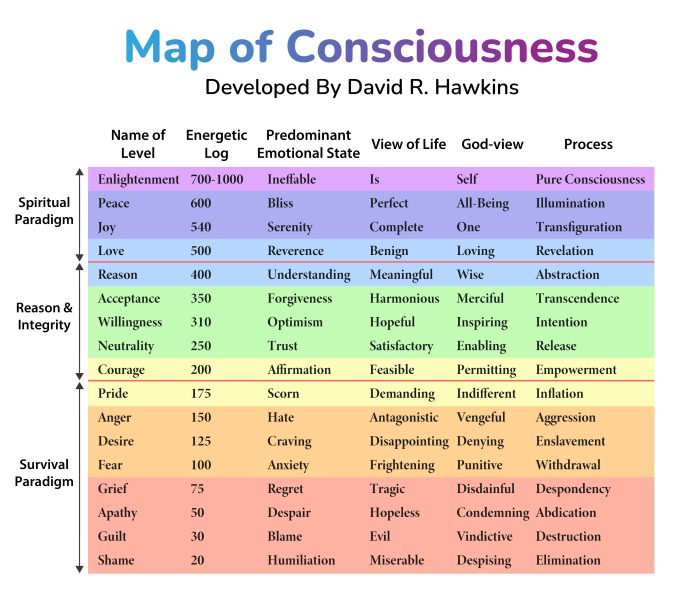
Emotions as they relate to different Levels of Consciousness on the scale low to high

Think of this scale not as good vs bad people, but as states of awareness that shape how emotions are felt, interpreted, and acted upon.


LOWER CONSCIOUSNESS STATES (Below 200)

These levels are dominated by contraction, survival, and ego-defence. Emotions here feel heavy, reactive, and draining.

Shame (20) – Destructive, Self-Loathing

  • Core belief: “I am bad / unworthy.”
  • Emotion turns inward as self-hatred.
  • Often linked to abuse, humiliation, or deep trauma.
  • Behaviour: withdrawal, self-sabotage, secrecy.
  • Consciousness is collapsed — there is little sense of agency.

Guilt (30) – Remorse, Self-Judgment

  • Core belief: “I did something bad.”
  • Less destructive than shame, but still paralyzing.
  • Can lead to punishment cycles and chronic regret.
  • Behaviour: apologising excessively, people-pleasing, stagnation.

Apathy (50) – Hopelessness

  • Core belief: “Nothing matters.”
  • Emotional numbness, depression, learned helplessness.
  • Behaviour: disengagement, minimal effort, passivity.
  • Life feels like something happening to you.

Grief (75) – Sadness, Loss

  • Core belief: “Something important is gone.”
  • More energy than apathy, but still backward-looking.
  • Behaviour: mourning, emotional pain, longing.
  • Healing often begins here — grief acknowledges truth.

Fear (100) – Anxiety, Survival Mode

  • Core belief: “I am not safe.”
  • Constant scanning for threats.
  • Behaviour: avoidance, control, worry, rigidity.
  • Energy is contracted and future-focused.

Desire (125) – Craving, Addiction

  • Core belief: “I’ll be okay when I get…”
  • Motivation driven by lack.
  • Behaviour: chasing pleasure, status, validation.
  • Can be productive, but never satisfying.

Anger (150) – Frustration, Force

  • Core belief: “This is wrong / unfair.”
  • Much more energy than fear or desire.
  • Behaviour: confrontation, blame, activism.
  • Can be destructive or the fuel for change.

Pride (175) – Defensiveness

  • Core belief: “I’m better than others.”
  • Temporary confidence masking insecurity.
  • Behaviour: comparison, superiority, rigidity.
  • Growth is resisted — the ego protects its image.

THE PIVOT POINT

Courage (200) – Empowerment

  • Core belief: “I can handle this.”
  • This is the turning point from force to power.
  • Behaviour: responsibility, action, honesty.
  • Life is no longer something you endure — you engage with it.

HIGHER CONSCIOUSNESS STATES (Above 200)

These levels are characterised by expansion, integration, and inner stability.

Neutrality (250) – Non-Judgment

  • Core belief: “It is what it is.”
  • Emotional flexibility and calm.
  • Behaviour: letting go, adaptability.
  • Drama loses its grip.

Willingness (310) – Optimism, Discipline

  • Core belief: “I want to grow.”
  • Energy becomes cooperative and constructive.
  • Behaviour: learning, helping, persistence.
  • Failure is seen as feedback.

Acceptance (350) – Responsibility

  • Core belief: “I create my experience.”
  • Emotional maturity and forgiveness.
  • Behaviour: ownership, accountability.
  • Victimhood dissolves.

Reason (400) – Understanding

  • Core belief: “There is order and logic.”
  • Emotion is balanced by intellect.
  • Behaviour: problem-solving, systems thinking.
  • Science, law, and rational inquiry flourish here.

TRANSCENDENT STATES

Love (500) – Unconditional Care

  • Core belief: “We are connected.”
  • Emotion is expansive, warm, inclusive.
  • Behaviour: compassion, generosity.
  • Love is a state of being, not an attachment.

Joy (540) – Serenity

  • Core belief: “Life is perfect as it is.”
  • Deep inner happiness without cause.
  • Behaviour: presence, gratitude, service.
  • Little need to prove or protect.

Peace (600) – Bliss

  • Core belief: “All is well.”
  • Silence, stillness, awe.
  • Behaviour: minimalism, contemplation.
  • The sense of a separate self fades.

Enlightenment (700–1000) – Pure Consciousness

  • No belief — only awareness.
  • Emotion transcends polarity.
  • Behaviour: spontaneous wisdom.
  • Rare, non-dual states reported by mystics and sages.

Key Insight

People don’t live permanently at one level.
They move up and down based on stress, awareness, healing, and choice.

The real work is not “being perfect” —
it’s recognising where you are, and choosing the next higher state available to you.

« Older posts Newer posts »

Step-up and get your seat on my VIP Emotional Intelligence Mentorship Program for 2026

X
Back a Buddy Show your Support