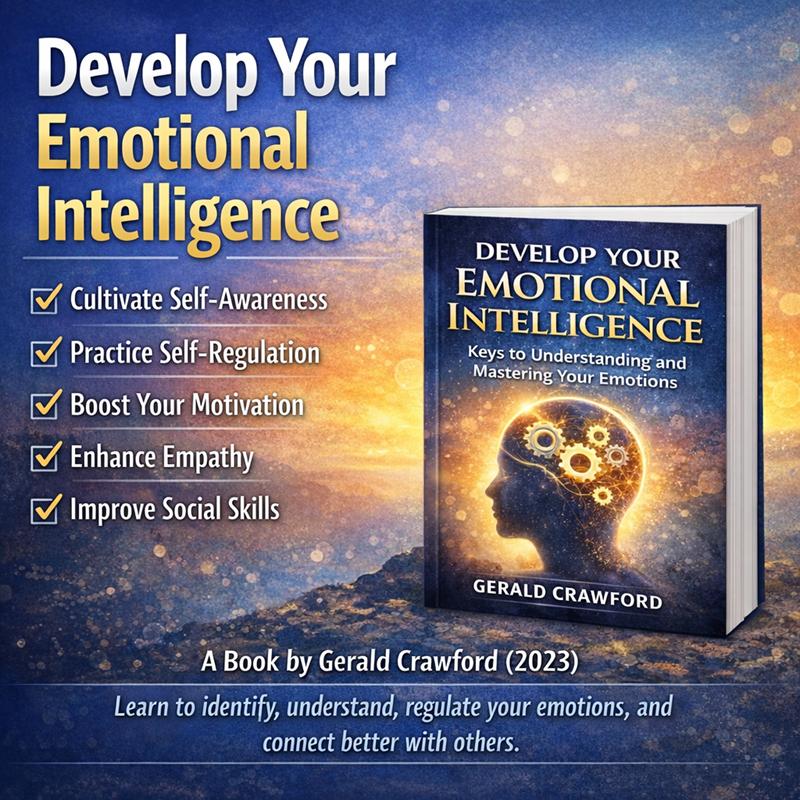
Development your Emotional Intelligence - A Book by Gerald Crawford (2023 Edition)

To develop Emotional Intelligence (EI), cultivate self-awareness by identifying and naming your emotions, self-regulation by managing those feelings, motivation by setting goals, empathy by understanding others' perspectives, and improving social skills through active listening and clear communication.

Empathy – Understanding others’ perspectives and emotional states

Empathy is what turns emotional intelligence outward.

It’s the ability to step into someone else’s inner world – to understand what they feel and why – without losing yourself.


What Is Empathy?

Empathy is your ability to:

  • Perceive what someone else is feeling
  • Understand their perspective
  • Feel with them (not just for them)
  • Respond appropriately

It’s not agreement. It’s understanding.


The 3 Layers of Empathy

1. Cognitive Empathy (Understanding)

  • “I see how they’re thinking”
  • You understand their perspective logically

Useful in business, negotiation, leadership


2. Emotional Empathy (Feeling)

  • “I feel what they’re feeling”
  • You emotionally resonate with them

Builds deep human connection


3. Compassionate Empathy (Action)

  • “I understand and want to help”
  • You respond in a supportive, constructive way

This is empathy in motion


1. Listening Beyond Words

Most people listen to reply.
Empathy requires listening to understand.

Pay attention to:

  • Tone of voice
  • Body language
  • What’s not being said
  • Emotional shifts

Often the real message is beneath the words.


2. Perspective-Taking

Ask yourself:

  • What might they be going through right now?
  • What would this situation feel like from their side?
  • What pressures or fears might they have?

Example:

Instead of:

  • “They’re being difficult”

Shift to:

  • “They might feel unheard or under pressure”

This reduces judgment and opens understanding.


3. Reflecting Back

One of the most powerful empathy tools:

  • “It sounds like you’re feeling frustrated because…”
  • “I can see why that would upset you”

People don’t calm down when you fix things.
They calm down when they feel understood.


4. Separating Understanding from Agreement

You can say:

  • “I understand why you feel that way”

Without saying:

  • “You’re right”

Empathy does not mean losing your boundaries.


Common Empathy Killers

  • Interrupting
  • Giving advice too quickly
  • Minimizing (“It’s not that bad”)
  • Making it about you
  • Judging (“You shouldn’t feel like that”)

These shut people down instantly.


Practical Exercise (Daily Use)

In your next conversation:

  1. Listen without interrupting
  2. Identify the emotion
  3. Reflect it back
  4. Ask one deeper question

Example:

  • “You sound stressed—what’s been weighing on you?”

Why Empathy Matters

Without empathy:

  • Miscommunication increases
  • Relationships become transactional
  • Conflict escalates

With empathy:

  • Trust deepens
  • Influence increases
  • Conflict resolves faster

The Balance

Too little empathy → cold, disconnected
Too much empathy (without boundaries) → drained, overwhelmed

The goal is understanding + strength


Deeper Truth

People don’t need you to solve everything.
They need to feel seen, heard, and understood.

That’s what empathy delivers.

Self-Regulation – Managing emotional responses and impulses

Self-regulation is where self-awareness becomes real power.

It’s not about suppressing emotions – it’s about directing them instead of being driven by them.


What Is Self-Regulation?

Self-regulation is your ability to:

  • Pause before reacting
  • Manage emotional intensity
  • Choose your response consciously
  • Stay aligned with your values under pressure

In simple terms:
Feel everything. React wisely.


The Core Problem

Most people live in a loop:

Trigger → Emotion → Reaction → Regret

Self-regulation inserts one critical step:

Trigger → Emotion → Pause → Chosen Response → Better Outcome


1. The Pause (Your Superpower)

The gap between feeling and reacting is where control lives.

How to create it:

  • Take 1–3 slow breaths
  • Count to 5
  • Physically step back or stay silent briefly

Even a 2-second pause can stop damage.


2. Managing Emotional Intensity

You can’t think clearly when emotions are at 90%.

Techniques to regulate intensity:

  • Breathing: slow inhale (4 sec), slow exhale (6–8 sec)
  • Grounding: notice 5 things you see, 4 you feel, 3 you hear
  • Movement: walk, stretch, shake tension out
  • Cold water: splash face or hold something cold

Calm the body → the mind follows.


3. Reframing the Situation

Your interpretation drives your reaction.

Shift your thinking:

  • From: “They’re disrespecting me”
  • To: “Maybe they’re stressed or unaware”
  • From: “This is a disaster”
  • To: “This is uncomfortable, but manageable”

You’re not lying to yourself—you’re choosing a more useful perspective.


4. Choosing a Response (Not a Reaction)

Ask yourself:

  • What outcome do I actually want here?
  • Will this reaction move me closer or further from it?

Examples:

  • Anger → instead of attacking → set a boundary calmly
  • Anxiety → instead of avoiding → take one small step forward
  • Frustration → instead of quitting → adjust approach

5. Building Emotional Discipline

Self-regulation is a trained skill, not a personality trait.

Daily habits:

  • Delay impulses (e.g., wait before replying to messages)
  • Practice staying calm in small irritations
  • Reflect after emotional moments:
    • What did I feel?
    • How did I respond?
    • What would I do differently next time?

Discipline in small moments = control in big moments.


What Self-Regulation Is NOT

  • Suppressing emotions
  • Pretending everything is fine
  • Being passive or avoiding conflict

It’s about responding with intention and strength


The Real Shift

Without self-regulation:

  • Emotions control your behavior
  • You damage relationships, decisions, and opportunities

With self-regulation:

  • You stay calm under pressure
  • You become predictable, trustworthy, and powerful

A Simple Formula

Notice → Pause → Regulate → Choose

Repeat this enough, and it becomes automatic.


Deeper Truth

Self-regulation is not about controlling emotions.
It’s about controlling what your emotions do next.

Self-Awareness – Identifying, naming, and understanding emotions

Self-awareness – especially around emotions – is one of the most powerful skills you can develop. It’s the foundation of emotional intelligence, better decision-making, and stronger relationships.

Let’s break it down clearly and practically:


What Is Emotional Self-Awareness?

Emotional self-awareness is your ability to:

  • Notice what you’re feeling
  • Name the emotion accurately
  • Understand why you feel that way
  • Recognize how it influences your behavior

It moves you from reacting automatically → to responding intentionally.


1. Identifying Emotions (Noticing)

This is about catching emotions as they arise, not after they’ve already driven your behavior.

Signals to look for:

  • Body cues: tight chest, clenched jaw, fatigue, restlessness
  • Thought patterns: “This isn’t fair,” “I’m not good enough,” “They don’t respect me”
  • Behavior shifts: withdrawing, snapping, over-talking, shutting down

Most people skip this step and only realize emotions after damage is done.


2. Naming Emotions (Labeling)

Many people default to basic labels like:

  • “I’m angry”
  • “I’m stressed”
  • “I’m fine”

But emotional precision matters.

Go deeper:

  • Instead of angry → frustrated, resentful, irritated, disrespected
  • Instead of sad → disappointed, rejected, lonely, discouraged
  • Instead of stressed → overwhelmed, pressured, anxious, uncertain

Research shows that naming emotions reduces their intensity (this is called affect labeling).


3. Understanding Emotions (Meaning)

Every emotion carries a message.

Ask yourself:

  • What triggered this?
  • What does this feeling say about what I value?
  • What need is not being met?

Examples:

  • Anger → boundary crossed
  • Anxiety → uncertainty or lack of control
  • Sadness → loss or unmet expectation
  • Jealousy → fear of losing something important

Emotions are not problems—they are data.


4. Connecting Emotions to Behavior

This is where self-awareness becomes powerful.

Ask:

  • How is this emotion influencing what I’m about to do?
  • Is this reaction helping or hurting me?

Example:

  • Feeling disrespected → snapping at someone → damages relationship
  • Feeling anxious → overworking → burnout

Awareness creates a pause between feeling and action.


Practical Exercise (Daily 2-Minute Check-In)

Try this simple structure:

  1. What am I feeling right now?
  2. Where do I feel it in my body?
  3. What triggered it?
  4. What do I need right now?

Do this:

  • After meetings
  • During conflict
  • Before making decisions

The Real Shift

Without self-awareness:

  • You are controlled by emotions

With self-awareness:

  • You work with emotions

A Deeper Truth

Self-awareness is not about “fixing” yourself.
It’s about knowing yourself clearly enough that your emotions stop running your life unconsciously.

Case Study 38: Developing Emotional Intelligence building Enlightenment (700–1000): Pure consciousness.

Case Study 38: Developing Emotional Intelligence and Realising Enlightenment

Consciousness Level: Enlightenment (700–1000)
State: Pure consciousness


Background

There is no longer a conventional biography.
The person once known as Elias (68) still functions in the world, but identity is no longer organised around a personal story. Life continues — walking, speaking, teaching, resting — yet none of it is experienced as “mine.”

Enlightenment did not arrive as a dramatic event. It arrived as the quiet disappearance of the one who was seeking.


Inner Landscape at the Level of Enlightenment

At this level, belief is replaced by knowing:
“There is only what is.”

The inner landscape is characterised by:

  • Absence of psychological identity

  • Awareness without centre

  • Love without object

  • Silence that is alive and intelligent

This is not emotional regulation — it is freedom from emotional ownership.


Relationships Without Identity

Relationships no longer function through roles or needs:

  • Those Once Loved and Cared For:
    Love remains, but without attachment or fear of loss.

  • Those Once Needed:
    Dependency dissolves into mutual presence.

  • Those Once Tolerated or Felt Indifferent To:
    Separation disappears entirely.

There is no “other” — only expressions of the same consciousness.


Behavioural Expression

Behaviour appears ordinary but carries unusual clarity:

  • Action arises spontaneously

  • Speech is simple, precise, and kind

  • No impulse to control outcomes

  • No emotional residue after interaction

Nothing is performed. Everything is happening.


The Realisation: No One Is Doing This

The pivotal realisation is:

There has never been a separate self.

What once felt like “personal effort” is recognised as movement within consciousness itself.


Emotional Intelligence at Enlightenment

Here, EI is not a skill — it is irrelevant as a concept. Yet its essence is fully embodied:


1. Emotions Without Ownership

Emotions may arise:

  • Without resistance

  • Without identification

  • Without narrative

They pass like ripples on water.


2. Compassion Without Choice

Compassion is automatic:

  • Not ethical

  • Not learned

  • Not selective

It is the natural expression of unity.


3. Intelligence Without Thought

Understanding occurs instantly:

  • No analysis

  • No judgment

  • No delay

Knowing precedes thinking.


Beyond the Consciousness Scale

Enlightenment is not a level on the scale — it is the dissolution of the scale itself.

  • No movement upward

  • No further development

  • No attainment

Only being.


Outcome

Life continues:

  • Without fear

  • Without seeking

  • Without psychological suffering

  • Without resistance

Joy, peace, love, and clarity are no longer states — they are the texture of awareness itself.


Final Learning

Enlightenment is not becoming something greater.
It is remembering what was never absent.

When emotional intelligence completes its journey, it dissolves into pure consciousness — silent, infinite, and whole.

Case Study 36: Developing Emotional Intelligence building Peace (600): Bliss, illumination.

Case Study 36: Developing Emotional Intelligence and Building Peace

Consciousness Level: Peace (600)
Emotional State: Bliss, illumination


Background

Zanele (61) speaks little, yet her presence is unmistakable. Time seems to slow around her. She has lived fully — raising children, losing loved ones, facing illness — and none of it left bitterness. Peace did not arrive through effort or discipline; it emerged when seeking ended.

Nothing needed to be different.


Emotional Landscape at the Level of Peace

At the Peace level, the core knowing is:
“All is well, exactly as it is.”

Zanele’s inner world is characterised by:

  • Profound stillness

  • Effortless joy

  • Deep compassion without attachment

  • A sense of unity beyond identity

Peace is not an emotion — it is a state of being.


Impact on Relationships

Peace transformed relationships at their root:

  • Those She Loved and Cared For:
    Love flowed without ownership or fear of loss.

  • Those She Needed:
    Roles dissolved into shared humanity.

  • Those She Tolerated or Felt Indifferent To:
    Separation faded; compassion became universal.

Relationships were no longer central — presence was.


Behavioural Patterns

Behaviour at Peace appears simple, almost ordinary:

  • Listening more than speaking

  • Acting only when action arises naturally

  • Responding without mental commentary

  • Living without urgency or resistance

Actions came from stillness, not intention.


The Turning Point: The End of Seeking

Zanele’s defining realisation was:

There is nothing to improve — only to notice.

When the search for meaning, happiness, or self-betterment ended, peace revealed itself.


Developing Emotional Intelligence

At Peace, emotional intelligence is complete integration rather than development. Still, three qualities were evident:


1. Dissolution of Emotional Ownership

Emotions arose but were no longer personal:

  • No identification with feeling states

  • No narrative attached to emotion

Emotion flowed like weather through open sky.


2. Effortless Compassion

Compassion was no longer practiced:

  • It was automatic

  • Non-selective

  • Without fatigue

Care extended equally to self, others, and life itself.


3. Awareness Without Centre

Zanele experienced awareness without a fixed “self”:

  • No internal conflict

  • No need to defend or define identity

This was illumination — seeing without distortion.


Movement Beyond the Consciousness Scale

Peace sits at the threshold of transcendence:

  • From Peace (600) → stillness and unity

  • Toward Enlightenment (700–1000) → pure consciousness

  • Beyond identity, emotion, and form

Here, growth gives way to being.


Outcome

Over time, Zanele experienced:

  • Continuous inner stillness

  • Absence of fear or resistance

  • Deep, silent joy

  • A sense of unity with all life

Life no longer happened to her — it happened as her.


Key Learning

Peace is not the absence of disturbance — it is the absence of resistance.

When emotional intelligence fully matures, peace becomes the natural ground of existence: blissful, luminous, and unshakeable.

« Older posts

Step-up and get your seat on my VIP Emotional Intelligence Mentorship Program for 2026

X
Back a Buddy Show your Support