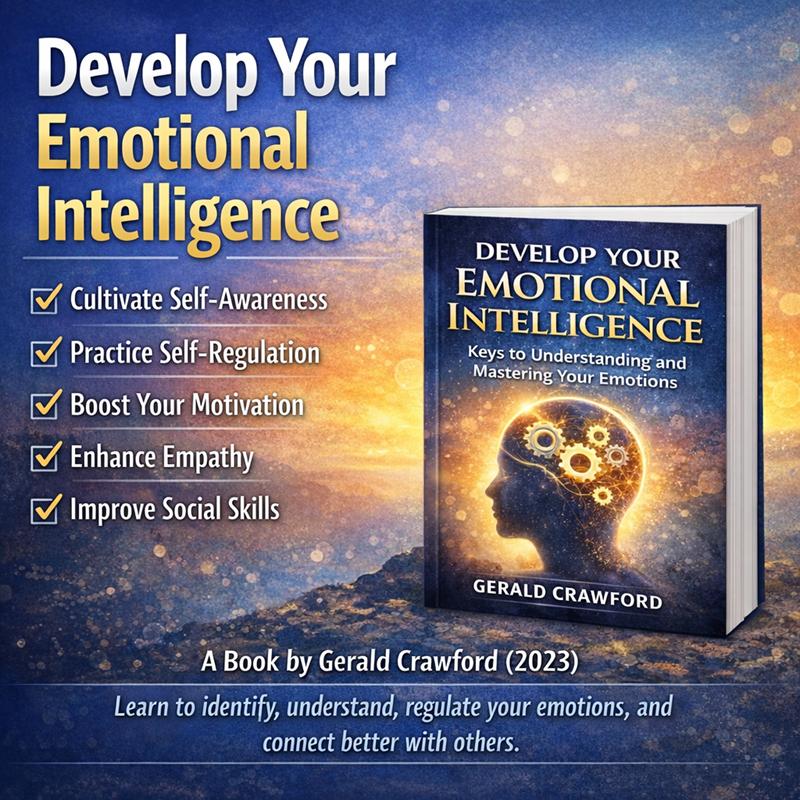
Development your Emotional Intelligence - A Book by Gerald Crawford (2023 Edition)

To develop Emotional Intelligence (EI), cultivate self-awareness by identifying and naming your emotions, self-regulation by managing those feelings, motivation by setting goals, empathy by understanding others' perspectives, and improving social skills through active listening and clear communication.

Page 8 of 46

40 Signs that you are Emotionally Intelligent

Emotional intelligence (EI) is multifaceted, so expanding to 40 signs allows us to cover the full spectrum: self-awareness, self-regulation, motivation, empathy, and social skills. Here’s a comprehensive list:


Self-Awareness

  1. You understand your emotions clearly.

  2. You can name your feelings accurately.

  3. You recognize the causes of your emotions.

  4. You notice early signs of emotional reactions.

  5. You are aware of your strengths and weaknesses.

  6. You reflect on your actions and decisions.

  7. You accept responsibility for your feelings and behaviors.

  8. You are honest with yourself about your motives.

Self-Regulation

  1. You stay calm in stressful situations.

  2. You pause before reacting emotionally.

  3. You avoid making impulsive decisions.

  4. You manage frustration without lashing out.

  5. You can let go of negative emotions quickly.

  6. You practice mindfulness or self-reflection regularly.

  7. You are adaptable to unexpected changes.

  8. You maintain composure even under criticism.

Motivation

  1. You set meaningful personal goals.

  2. You pursue goals with persistence despite setbacks.

  3. You are optimistic about your potential.

  4. You are intrinsically motivated, not just by rewards.

  5. You embrace challenges as opportunities to grow.

  6. You celebrate small achievements along the way.

  7. You are committed to self-improvement.

  8. You maintain focus even when progress is slow.

Empathy

  1. You notice and understand others’ emotions.

  2. You listen actively without interrupting.

  3. You validate others’ feelings, even if you disagree.

  4. You can sense non-verbal emotional cues.

  5. You are patient with people who are struggling.

  6. You are considerate and respectful in your responses.

  7. You can see situations from another person’s perspective.

  8. You are compassionate and willing to help.

Social Skills

  1. You communicate clearly and assertively.

  2. You maintain healthy boundaries.

  3. You resolve conflicts calmly and constructively.

  4. You inspire trust and confidence in others.

  5. You collaborate effectively in teams.

  6. You influence and motivate others positively.

  7. You build meaningful and lasting relationships.

  8. You give and receive praise graciously.


Insight:

Someone with high emotional intelligence demonstrates a balance of self-awareness, self-control, motivated persistence, empathy, and strong social skills. These traits often lead to better relationships, higher personal resilience, and a deeper understanding of oneself and others.

Detail Description of Negative Emotions

Let’s break down negative emotions in a detailed, clear, and practical way, so you can recognize, feel, and work with them effectively. I’ll focus on their definition, causes, physical sensations, psychological patterns, and potential lessons or growth opportunities.


Detailed Description of Negative Emotions


1. Anger

Definition:
A strong emotional response to perceived injustice, frustration, or boundary violations.

Causes/Triggers:

  • Feeling disrespected, rejected, or powerless.

  • Violated personal boundaries.

  • Unmet expectations or injustice.

Physical Sensations:

  • Tension in jaw, neck, shoulders.

  • Increased heart rate, heat in the face, clenching fists.

  • Restlessness or urge to act.

Psychological Patterns:

  • Irritability, resentment, aggression.

  • Blaming others or oneself.

  • Suppressed anger can turn into passive-aggressiveness or depression.

Potential Growth:

  • Assertiveness and setting healthy boundaries.

  • Channeling energy into constructive action.

  • Increased self-respect and clarity about values.


2. Fear/Anxiety

Definition:
A response to perceived threat or uncertainty, real or imagined. Anxiety is often fear about future possibilities.

Causes/Triggers:

  • Unknown outcomes or uncertainty.

  • Past trauma or danger.

  • Overthinking or catastrophic thinking.

Physical Sensations:

  • Rapid heartbeat, shortness of breath, trembling.

  • Tightness in chest, stomach discomfort, sweating.

  • Muscle tension, frozen or hyperactive states.

Psychological Patterns:

  • Worry, obsessive thoughts, avoidance behavior.

  • Difficulty concentrating or decision-making.

  • Hypervigilance or feeling “on edge.”

Potential Growth:

  • Developing courage, problem-solving, and preparation skills.

  • Learning to tolerate uncertainty and trust oneself.

  • Increased mindfulness and self-regulation.


3. Sadness/Grief

Definition:
A response to loss, disappointment, or unmet emotional needs.

Causes/Triggers:

  • Loss of loved ones, relationships, or opportunities.

  • Unfulfilled expectations.

  • Reflecting on regrets or mistakes.

Physical Sensations:

  • Heaviness in chest or body.

  • Low energy, tearfulness, fatigue.

  • Appetite or sleep changes.

Psychological Patterns:

  • Withdrawal, rumination, hopelessness.

  • Self-pity or self-criticism.

  • Over-identification with pain if prolonged.

Potential Growth:

  • Emotional processing and closure.

  • Compassion for self and others.

  • Deeper appreciation of joy and connection.


4. Guilt

Definition:
Feeling responsible for wrongdoing or failing to meet one’s own or others’ standards.

Causes/Triggers:

  • Actions that conflict with personal values.

  • Hurting others, intentionally or unintentionally.

  • Social or cultural conditioning of “shoulds.”

Physical Sensations:

  • Tightness in chest, stomach discomfort.

  • Restlessness or agitation.

  • Headaches or tension.

Psychological Patterns:

  • Rumination, self-blame, shame.

  • Over-apologizing or self-punishment.

  • Difficulty forgiving oneself.

Potential Growth:

  • Learning accountability without self-condemnation.

  • Making amends and improving behavior.

  • Greater moral clarity and empathy.


5. Shame

Definition:
A deep feeling of unworthiness or that one is fundamentally flawed.

Causes/Triggers:

  • Criticism or rejection from others.

  • Personal failure or perceived inadequacy.

  • Internalized societal expectations.

Physical Sensations:

  • Blushing, downward gaze, slumped posture.

  • Tight throat or stomach discomfort.

  • Desire to hide or disappear.

Psychological Patterns:

  • Self-criticism, avoidance, social withdrawal.

  • People-pleasing or perfectionism.

  • Internalized negative beliefs about self.

Potential Growth:

  • Developing self-compassion and acceptance.

  • Reducing over-identification with mistakes.

  • Building authentic self-expression.


6. Jealousy/Envy

Definition:
Feeling threatened or inadequate when comparing oneself to others.

Causes/Triggers:

  • Perceived loss of status, attention, or affection.

  • Comparing life circumstances or achievements.

  • Fear of being left behind or missing out.

Physical Sensations:

  • Tight chest, tension, or stomach discomfort.

  • Restlessness, agitation.

  • Increased focus on others rather than self.

Psychological Patterns:

  • Resentment, bitterness, competitiveness.

  • Rumination on unfairness or desire for what others have.

  • Self-esteem challenges.

Potential Growth:

  • Motivation to improve oneself constructively.

  • Learning gratitude and appreciation.

  • Recognizing and celebrating others’ successes.


7. Frustration

Definition:
A response to obstacles, delays, or unfulfilled goals.

Causes/Triggers:

  • External challenges or resistance.

  • Personal limitations or mistakes.

  • Unrealistic expectations.

Physical Sensations:

  • Muscle tension, especially hands and jaw.

  • Restlessness or fidgeting.

  • Feeling stuck or impatient.

Psychological Patterns:

  • Irritability, anger, or giving up.

  • Blaming external circumstances.

  • Increased stress and agitation.

Potential Growth:

  • Developing patience, perseverance, and problem-solving skills.

  • Acceptance of limits and adaptability.

  • Building resilience in challenges.


8. Loneliness/Isolation

Definition:
Feeling disconnected, unseen, or unsupported.

Causes/Triggers:

  • Lack of social connection or intimacy.

  • Feeling misunderstood or rejected.

  • Life transitions or self-imposed isolation.

Physical Sensations:

  • Heaviness in chest, fatigue.

  • Low energy, tension, or restlessness.

  • Somatic feelings of emptiness.

Psychological Patterns:

  • Withdrawal, negative self-talk.

  • Overdependence on external validation.

  • Anxiety about social interactions.

Potential Growth:

  • Strengthening self-reliance and self-love.

  • Learning to build healthy relationships.

  • Appreciating solitude and introspection.


Key Points Across All Negative Emotions

  1. All emotions are signals – they tell us something important about needs, boundaries, and values.

  2. Negative emotions are not “bad” – avoiding them can cause greater suffering.

  3. Mindful observation allows processing rather than suppression.

  4. Physical awareness is crucial – emotions are stored in the body.

  5. Healing comes through acknowledgment, expression, and transformation.

Teaching and Healing Program Feeling, Understanding and Navigating Negative Emotions

Here is a structured Teaching and Healing Program focused on Feeling, Understanding, and Navigating Negative Emotions. I’ll make it step-by-step, combining emotional intelligence, mindfulness, hypnotherapy principles, and practical exercises for both self-awareness and emotional regulation. Here’s a comprehensive program:


Program Title:

“Emotional Mastery: Feeling, Understanding, and Navigating Negative Emotions”

Duration:

6–8 Weeks (Flexible; can be adjusted for daily or weekly practice)

Objective:

To help individuals recognize, accept, and transform negative emotions (anger, fear, sadness, guilt, shame, anxiety) into conscious awareness and emotional growth, improving mental well-being, relationships, and resilience.


Week 1: Awareness of Emotions

Goal: Learn to recognize and name negative emotions without judgment.

Key Concepts:

  • Emotions are signals, not threats.

  • Emotional labeling reduces intensity.

Activities:

  1. Daily Emotional Check-in: Track emotions 3–5 times per day; note triggers, intensity (1–10), and body sensations.

  2. Mindful Observation: 5–10 minutes of sitting quietly, noticing any emotions present without trying to change them.

  3. Guided Visualization: Imagine each emotion as a color or shape in the body. Observe its location and intensity.

Healing Exercise:

  • Hypnotherapy-style relaxation: “Breathe in calm, breathe out tension. Observe emotions as passing clouds in the sky.”


Week 2: Understanding Negative Emotions

Goal: Learn the meaning behind emotions and their roots.

Key Concepts:

  • Every negative emotion carries a message (e.g., anger = boundary being crossed, fear = uncertainty, sadness = loss).

  • Distinguish between primary emotions (direct reactions) and secondary emotions (emotional reactions to emotions).

Activities:

  1. Emotion Mapping: Write down a recent emotional episode. Identify primary emotion → secondary emotion → trigger.

  2. Reflective Journaling: Ask: “What is this emotion trying to tell me?”

  3. Somatic Awareness: Scan the body during emotional episodes to notice tension patterns.

Healing Exercise:

  • EFT Tapping (Emotional Freedom Technique) on core emotions, e.g., anger, fear, or sadness.


Week 3: Accepting and Feeling Emotions Fully

Goal: Reduce avoidance and suppression.

Key Concepts:

  • Suppressed emotions manifest as stress, anxiety, or physical pain.

  • Fully feeling emotions allows natural release and healing.

Activities:

  1. Body-Focused Practice: Lie down and consciously feel sensations associated with an emotion.

  2. Expressive Writing: Write a letter to your emotion. Let it speak freely.

  3. Emotional Release Techniques: Safe methods like crying, journaling, movement, or punching a pillow.

Healing Exercise:

  • Guided meditation: “I allow myself to feel this emotion fully and safely. I am bigger than this feeling.”


Week 4: Managing Emotional Triggers

Goal: Recognize and reduce reactivity.

Key Concepts:

  • Emotional triggers often relate to past experiences.

  • Pause, breathe, and respond consciously rather than react.

Activities:

  1. Trigger Identification: List recurring situations and emotions.

  2. Pause and Breath: 4-7-8 breathing when triggered.

  3. Cognitive Reframing: Ask: “Is this situation truly threatening? What else could this mean?”

Healing Exercise:

  • Self-hypnosis script for grounding and emotional resilience.


Week 5: Transforming Negative Emotions

Goal: Convert emotional energy into constructive action.

Key Concepts:

  • Emotions are energy. Redirect them positively.

  • Anger → assertiveness, fear → preparation, sadness → reflection and connection.

Activities:

  1. Channeling Exercise: Physical activity, art, or creative writing for emotional release.

  2. Solution-Focused Journaling: Instead of ruminating, ask: “What can I do constructively?”

  3. Gratitude and Self-Compassion Practice: Counterbalance negative emotional weight.

Healing Exercise:

  • Visualization: Imagine transforming anger into a glowing light of courage and strength.


Week 6: Integrating Emotional Intelligence

Goal: Apply learned skills in real life and strengthen emotional resilience.

Key Concepts:

  • Emotional intelligence = awareness + understanding + regulation + empathy.

  • Resilience grows when emotions are consciously acknowledged and processed.

Activities:

  1. Role-Playing: Practice responding calmly in emotionally charged situations.

  2. Mindful Communication: “I feel… because…” statements with empathy.

  3. Daily Reflection: Evening journaling to review emotional patterns and growth.

Healing Exercise:

  • Body-mind integration: 10-minute guided meditation connecting breath, body, and emotions.


Ongoing Practices

  • Daily: 5–10 min mindfulness and emotional check-in.

  • Weekly: Reflective journaling and review of triggers/responses.

  • Monthly: Deep emotional release and hypnotherapy or EFT session.


Expected Outcomes

  • Increased emotional awareness and self-understanding.

  • Ability to regulate emotions without suppression or overreaction.

  • Improved mental clarity, relationships, and resilience.

  • Healthier expression of emotions and reduced stress.

Activate Pride, Accomplishment: Satisfaction in your abilities or achievements with Hypnotherapy

Here’s a hypnotherapy script to help activate pride, accomplishment, and satisfaction in your abilities or achievements:

Introduction

(Soft, uplifting music starts playing. Speak in a gentle, encouraging tone.)

“Welcome to this hypnotherapy session, where you’ll embark on a journey to unlock your inner pride, accomplishment, and satisfaction. Allow yourself to relax, breathe deeply, and let go of any self-doubt or limitations. You’re safe, and you’re in control. Find a comfortable position, either sitting or lying down, and take a deep breath in… and out… Feel the air fill your lungs, and then release it slowly. As you exhale, imagine any worries or concerns leaving your body.”

Induction

“Close your eyes and begin to focus on your breath. Feel the sensation of the air moving in and out of your nostrils. Imagine a warm, golden light beginning to fill your body, starting at the crown of your head. As this light travels down through your face, neck, and shoulders, it awakens your inner confidence, your sense of self-worth, and your pride in your abilities. Allow this light to continue down through your arms, hands, chest, abdomen, lower back, and finally, your legs and feet. With each breath, feel yourself becoming more and more empowered, more and more confident, and more and more satisfied with your accomplishments.”

Deepening

“Imagine yourself standing in a place of achievement, where you’ve overcome challenges and accomplished your goals. See the sights, hear the sounds, and feel the sensations of success and pride. Visualize the faces of people who support and believe in you, and hear their words of encouragement and praise. As you breathe in, imagine fresh, clean air filling your lungs, and as you breathe out, imagine any self-doubt or limitations leaving your body. Repeat the following phrase to yourself: ‘I am capable, I am confident, I am proud of my accomplishments.'”

Unlocking Pride and Accomplishment

“Imagine a large, ornate box in front of you. This box represents your inner treasure chest of achievements and accomplishments. Visualize the box filling with memories of your successes, your achievements, and your triumphs. See the box overflowing with pride, satisfaction, and a sense of fulfillment. As you open the box, imagine a warm, golden light spilling out, filling your entire being with pride, confidence, and a sense of accomplishment. Repeat the following phrase to yourself: ‘I am proud of myself, I am proud of my abilities, I am proud of my achievements.'”

Reinforcing Positive Self-Talk

“Imagine yourself speaking to yourself in a kind, encouraging, and supportive tone. Hear yourself saying: ‘I am capable, I am confident, I am proud of my accomplishments.’ Repeat these phrases to yourself, allowing the words to sink deeply into your mind and heart. Imagine yourself responding to challenges with confidence, with courage, and with a sense of determination. See yourself overcoming obstacles, achieving your goals, and feeling a deep sense of satisfaction and pride.”

Empowerment

“Imagine a new, empowered version of yourself emerging. This version is confident, capable, and proud of your accomplishments. See yourself handling situations with ease, responding to challenges with confidence, and trusting yourself completely. Feel the sense of pride, the sense of accomplishment, and the sense of fulfillment that comes with knowing you’re in control. Repeat the following phrase to yourself: ‘I trust myself, I trust my abilities, I am capable and competent.’ Remember that you have the power to choose how you respond to any situation, and that you are always in control of your thoughts, emotions, and actions.”

Future Pacing

“Imagine yourself in a future scenario, where you’re facing a new challenge or opportunity. But this time, imagine yourself responding with confidence, with courage, and with a sense of determination. See yourself overcoming obstacles, achieving your goals, and feeling a deep sense of satisfaction and pride. Repeat the following phrase to yourself: ‘I am prepared, I am capable, I am in control.’ Know that you have the tools, the skills, and the inner strength to overcome any obstacle, and to achieve your goals.”

Counting Up and Awakening

“Take a deep breath in, and as you exhale, begin to slowly count up from one to five. With each number, feel yourself becoming more and more alert, more and more focused. When you reach the number five, you’ll be fully awake, feeling refreshed, renewed, and empowered. One… You’re beginning to stir, feeling a sense of calm and relaxation. Two… You’re becoming more alert, more focused. Three… You’re starting to feel more energized, more motivated. Four… You’re almost fully awake, feeling refreshed and renewed. Five… You’re now fully awake, feeling empowered, confident, and proud of your accomplishments. Take a deep breath in, and when you’re ready, you can open your eyes.”

Conclusion

“Remember, you are capable, you are confident, and you are proud of your accomplishments. Whenever you need to tap into your inner pride and satisfaction, take a deep breath, and remind yourself of the empowerment you’ve experienced in this session. You can return to this place of confidence and accomplishment whenever you need to, and you can always trust yourself to handle any situation with confidence and ease.”


Women’s-centered Healing – Inner Emotional Landscape, Attachment Wounds, and Survival Strategies

Below is a women’s-centered healing transmission that speaks directly to the inner emotional landscape, attachment wounds, and survival strategies – held in a feminine, trauma-informed, body-based tone.

This can be used for women’s circles, therapy, coaching, or hypnotherapy.

WOMEN’S HEALING:

Inner Emotional Landscape, Attachment Wounds & Survival Strategies

1. The Feminine Inner Emotional Landscape

The place where feeling lives

A woman’s inner emotional world is often deep, intuitive, relational, and body-led.

When safe, it flows as:

  • Emotional openness
  • Sensual presence
  • Intuition and creativity
  • Soft strength and receptivity

When wounded, it often becomes:

  • Hyper-empathic or emotionally exhausted
  • Self-abandoning
  • Anxious about connection
  • Disconnected from the body

Many women were taught:

“Be good. Be pleasing. Be quiet. Be strong for others.”

This shapes an inner landscape that feels others deeply—yet struggles to feel herself.

2. Core Attachment Wounds in Women

Abandonment

“I must hold on, over give, or disappear to be loved.”

Rejection

“My needs, emotions, or body are too much.”

Betrayal

“I cannot trust—especially men, authority, or my own intuition.”

Neglect

“No one is coming for me. I must manage alone.”

Enmeshment

“My worth depends on being chosen, needed, or desired.”

These wounds are often reinforced by:

  • Generational trauma
  • Cultural conditioning
  • Relationship trauma
  • Sexual or emotional boundary violations

A woman’s attachment wounds often live in her heart, womb, and throat.

3. Feminine Survival Strategies

How women learned to stay safe

Women’s survival strategies are often relational, not aggressive.

Common patterns:

  • People-pleasing – earning love through self-erasure
  • Over-giving – confusing love with sacrifice
  • Emotional monitoring – reading the room to stay safe
  • Attachment chasing – fear of being alone
  • Sexual compliance – using the body to secure connection
  • Emotional shutdown – freezing the heart after repeated hurt

These strategies once meant:

“I belong. I’m safe. I won’t be abandoned.”

4. The Hidden Cost

Survival can look like:

  • Chronic exhaustion
  • Anxiety in relationships
  • Loss of desire or vitality
  • Difficulty receiving
  • Disconnection from pleasure
  • Deep loneliness – even in partnership

The wound is not that you cared too much.

The wound is that no one taught you to care for yourself first.

5. Healing the Feminine (Trauma-Informed)

Women do not heal by pushing harder.

They heal through safety, slowness, and embodiment.

Healing requires:

  • Nervous system regulation
  • Permission to feel without explanation
  • Reconnection with the body
  • Healthy boundaries without guilt
  • Grief for the self that had to survive

Key shift:

From self-abandonment → to self-devotion

6. Feminine Hypnotherapy Reframe

“You were not weak—you were relational.
You were not needy—you were attachment-oriented.
You were not too emotional—you were unprotected.”

In trance or deep inner work:

  • The inner girl is met with attunement
  • The body learns it is no longer available for harm
  • The adult woman becomes her own safe attachment

7. Feminine Integration Statement

(Use in circles or sessions)

“I no longer abandon myself to be loved.
I choose presence over performance.
My body is safe.
My emotions are welcome.
I am whole—even when I am alone.”

8. Ritual Practice (Simple & Powerful)

Place one hand on your heart, one on your womb.

Breathe slowly and say:

“I am allowed to receive.
I am allowed to rest.
I am allowed to choose myself.”

« Older posts Newer posts »
Back a Buddy Show your Support