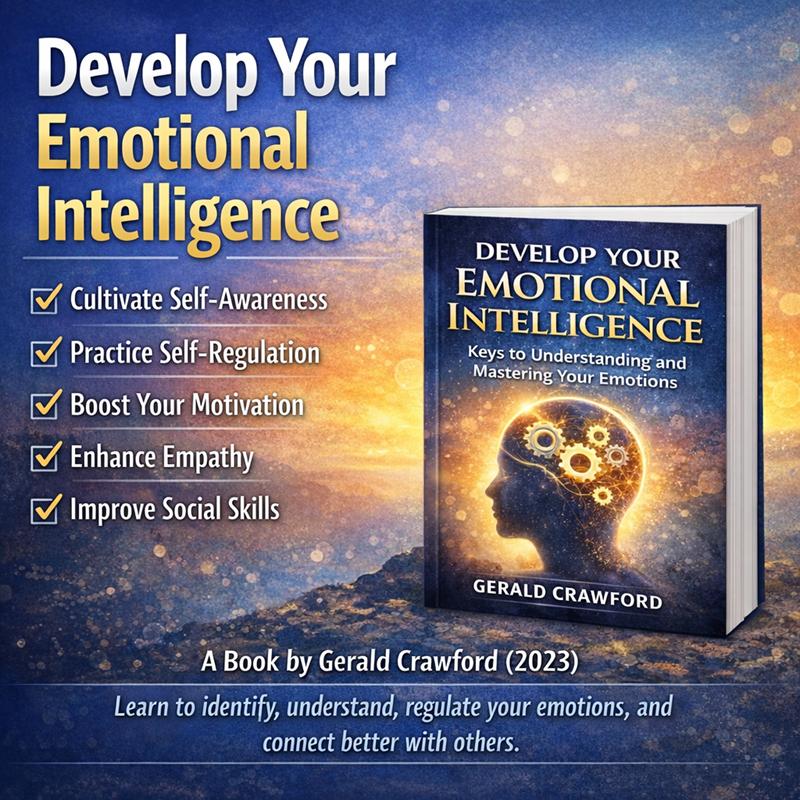
Development your Emotional Intelligence - A Book by Gerald Crawford (2023 Edition)

To develop Emotional Intelligence (EI), cultivate self-awareness by identifying and naming your emotions, self-regulation by managing those feelings, motivation by setting goals, empathy by understanding others' perspectives, and improving social skills through active listening and clear communication.

Page 4 of 46

Take Control of the impact of your emotions on your Behaviour and Decision-making with Hypnotherapy

Below is a word-for-word hypnotherapy script focused on taking control of how emotions influence behaviour and decision-making.

It’s written in a calm, grounded, emotionally intelligent style—strengthening awareness, choice, and self-leadership without suppressing emotion.


Hypnotherapy Script: Emotional Mastery & Conscious Choice

Preparation (spoken calmly and steadily):
Find a comfortable position…
Sitting or lying down…
And allow your eyes to gently close…
Or soften your gaze…

Take a slow breath in through your nose…
And exhale through your mouth…
Letting the body begin to settle…

Again…
Breathing in clarity…
Breathing out tension…

Good.


Induction: Regulating the Nervous System

Notice the natural rhythm of your breathing…
No effort… no control…
Just allowing…

Notice how your body is supported…
The surface beneath you holding your weight…

You don’t need to brace…
You don’t need to resist…
In this moment… you are safe enough to relax…

As your body relaxes…
Your nervous system settles…
And your mind becomes more receptive…


Deepening: Creating Inner Space

In a moment, I’ll count from five down to one
And with each number…
You can drift deeper into calm awareness…

Five… slowing down…
Four… muscles releasing…
Three… thoughts becoming quieter…
Two… awareness sharpening…
One… calm… clear… present…

Good.


Therapeutic Suggestions: Separating Emotion from Reaction

Now…
Bring your attention to your inner awareness…
The part of you that observes thoughts and feelings…

Emotions are information…
Not instructions…

You can feel deeply…
And still choose wisely…

Silently allow this idea to settle:

“I can experience emotion without being controlled by it.”

Notice how your body responds…
Perhaps a sense of steadiness…
Grounding…
Clarity…

Your subconscious mind is learning a new pattern now…


Building the Pause

From this moment forward…
Between emotion and action…
There is a pause…

A breath…
A moment of choice…

In that pause…
You regain control…

You ask yourself:

“What is the best response right now?”

And your nervous system learns that slowing down creates safety…
Not danger…


Strengthening Conscious Decision-Making

Now imagine yourself in a situation that once triggered you…
Nothing overwhelming…
Just familiar…

Notice the emotion arising…
And instead of reacting…
You pause…

You breathe…
You observe…

And then…
You choose a response aligned with your values…
Your goals…
Your integrity…

Notice how empowering that feels…

Your subconscious mind records this as success…
As leadership…
As self-control…


Installing Emotional Authority

From now on…
Emotions can arise…
Move through you…
And pass…

They inform you…
But they no longer drive you…

You are the one who decides…
Calmly…
Consciously…

And each time you choose awareness over impulse…
This ability strengthens…

Emotional intelligence becomes automatic…
Natural…
Reliable…


Future Pacing: Living in Control

See yourself moving through daily life…
Handling stress with clarity…
Communicating calmly…
Making decisions you respect…

You trust yourself now…
Because you are in charge of your inner state…

And your subconscious mind accepts this as your new identity…


Emergence

In a moment…
I’ll count from one up to five
And you’ll return feeling centred…
Empowered…
And clear-minded…

One… awareness returning…
Two… breath deepening…
Three… body feeling steady…
Four… mind alert and calm…
Five… eyes open when ready… feeling in control and grounded…


Closing Affirmation (optional):

“I feel my emotions, and I choose my actions.
I respond with clarity, calm, and control.”

Nervous System Healing – Visualize the MOON that manifest, rebirth, clears, enhances intuition

Nervous System Healing – The Moon Visualization

Settle into stillness.
Allow your body to rest exactly as it is.
Inhale gently through the nose…
and exhale slowly, as if releasing the day.


Visualize the Moon.

See it rising in the night sky—
soft, luminous, and steady.
This moon does not demand attention.
It invites surrender.

Its light is cool, cleansing, and wise.


Manifesting
As moonlight touches you, it activates quiet intention.
Not effort… not force…
but natural alignment.
Your nervous system begins to reorganize itself
around balance, harmony, and inner truth.

What you are ready for
begins to take shape effortlessly.


Rebirth
The moonlight washes over you like silver water.
Old stress patterns loosen.
Outdated survival responses dissolve.
Your system sheds what no longer belongs to you.

You are renewed—
not by becoming someone else,
but by returning to who you truly are.


Clearing
Feel the light moving through your mind,
your spine, your breath, your belly.
Emotional residue gently lifts and fades.
Mental noise quiets.

Your nervous system exhales deeply,
releasing what it has been holding too long.


Enhancing Intuition
The moon now glows within your chest
and behind your eyes.
Your inner senses sharpen softly.
You don’t need answers—
you recognize them.

Your body’s signals become clear.
Your instincts feel trustworthy.
You listen… and you understand.


Silently affirm:
“I allow release and renewal.”
“I trust my inner guidance.”
“My nervous system is calm, receptive, and wise.”


Rest here for a moment,
bathed in moonlight…
held in stillness…
supported by quiet knowing.

When you feel complete,
take a gentle breath in…
and slowly open your eyes,
carrying this clarity and calm into your night.

Nervous System Healing – Visualize the SUN that heals, charges, warms, illuminates, nourishes

Nervous System Healing – The Sun Visualization

Find a comfortable position. Allow your body to settle.
Gently close your eyes… and take a slow, deep breath in through the nose…
and a long, unhurried breath out through the mouth.


Visualize the Sun.

See it rising before you—
a calm, radiant sun, not harsh or blinding,
but perfectly warm, perfectly safe.

This sun is intelligent.
It knows exactly how to heal you.


Healing
As you breathe in, imagine golden sunlight flowing toward you.
It touches your skin and moves inward,
soothing every nerve, calming every signal.
Your nervous system begins to soften…
like tight strings gently loosening.


Charging
With each breath, the sun recharges you.
Not with urgency, but with steady, quiet power.
Your cells wake up refreshed.
Your body remembers how to restore itself naturally.


Warming
Feel the warmth spreading through your chest,
your belly, your shoulders, your spine.
Cold tension melts.
Safety replaces vigilance.
Your body understands: I am not in danger.


Illuminating
The sunlight now brightens your inner world.
Dark corners of stress and confusion gently dissolve.
Clarity replaces overwhelm.
Your mind becomes spacious, open, and clear.


Nourishing
This sun feeds you with calm, balance, and vitality.
Every system receives what it needs.
Your heart rhythm steadies.
Your breath becomes slow and natural.
Your nervous system returns to its original wisdom.


Silently say to yourself:
“I allow my nervous system to heal.”
“I am safe to relax.”
“My body knows how to regulate itself.”


Remain here for a few moments,
bathing in this golden light…
absorbing only what feels right.

When you’re ready,
take one deeper breath…
and gently open your eyes,
bringing this warmth and calm with you.

5 Jokes – Humour about “Emotional Intelligence”

Here you go – light, relatable humour that still gets Emotional Intelligence.

Perfect for social posts, slides, or breaking the ice in a workshop.


5 Jokes About Emotional Intelligence (EI)

  1. I didn’t lose my temper – I just strategically relocated it.
    That’s called emotional regulation. Look it up.

  2. Emotional Intelligence is realizing you’re triggered…and choosing silence instead of a 3-page WhatsApp voice note.

  3. Low EI: “I’m just being honest.”
    High EI: “I can be honest without emotionally detonating the room.”

  4. Emotional Intelligence is knowing your feelings are valid  –  and still not making them everyone else’s problem.

  5. Developing Emotional Intelligence means arguing less with people…and negotiating more with your own inner child.


Inspired by Develop Your Emotional Intelligence  – where self-awareness, self-regulation, empathy, motivation, and social skills are taken seriously…but not so seriously that we forget to laugh at ourselves

Case Study 22: Developing Emotional Intelligence and healing from Apathy (50): Giving up on life, hopelessness.

Case Study 22: Developing Emotional Intelligence and Healing from Apathy

Consciousness Level: Apathy (50)
Emotional State: Giving up on life, hopelessness


Background

Joseph (46) once described himself as “tired in a way sleep doesn’t fix.”
He was employed, physically healthy, and socially functional — yet emotionally disengaged from life. Nothing felt meaningful. Goals that once motivated him now felt pointless. He wasn’t actively depressed in a dramatic sense; he had simply stopped expecting life to improve.

Joseph had experienced years of quiet disappointments: career stagnation, the end of a long-term relationship, and repeated efforts that led nowhere. Over time, hope eroded. What remained was emotional shutdown.


Emotional Landscape at the Level of Apathy

At the Apathy level, the core belief is:
“Nothing I do will make a difference.”

Joseph’s emotional world was characterised by:

  • Emotional numbness

  • Low energy and motivation

  • Withdrawal from meaningful engagement

  • A sense of futility rather than sadness

Unlike grief, which feels heavy, apathy feels empty.


Impact on Relationships

Apathy reshaped Joseph’s relationships by removing emotional presence:

  • Those He Loved and Cared For:
    He became distant, not out of anger, but exhaustion. Loved ones felt shut out.

  • Those He Needed:
    He stopped advocating for himself, accepting poor treatment passively.

  • Those He Tolerated or Felt Indifferent To:
    He drifted into social invisibility, neither engaging nor resisting.

Apathy flattened relational dynamics — there was no conflict, but no connection either.


Behavioural Patterns

Joseph’s behaviours reflected emotional surrender:

  • Procrastination without anxiety

  • Neglect of long-term goals

  • Passive acceptance of unsatisfying situations

  • Minimal emotional expression

These behaviours were often misinterpreted as laziness, when in fact they signalled emotional depletion.


The Turning Point: Reintroducing Choice

Healing from apathy did not begin with passion or optimism.
It began with choice.

In therapy, Joseph was asked a deceptively simple question:

“What is one small action you could take today that contradicts giving up?”

This reframed life from an overwhelming burden to a series of manageable moments.


Developing Emotional Intelligence

Joseph rebuilt EI through three foundational steps:


1. Emotional Reconnection

Rather than forcing motivation, he focused on feeling anything:

  • Walking daily without goals

  • Listening to music mindfully

  • Naming bodily sensations

This gently reawakened emotional awareness.


2. Agency Restoration

Joseph practiced making small, deliberate choices:

  • Choosing when to engage

  • Choosing when to rest

  • Choosing what to tolerate

Each choice, however minor, weakened the belief that he was powerless.


3. Meaning Through Action

Meaning followed action — not the other way around.
Joseph committed to simple routines:

  • Regular meals

  • Light physical movement

  • Structured days

Consistency restored trust in himself.


Movement Up the Consciousness Scale

Joseph’s progression was subtle but transformative:

  • From Apathy (50) → emotional reconnection

  • To Grief (75) → allowing sadness and loss

  • Toward Courage (200) → reclaiming responsibility and engagement

Apathy lifted not through inspiration, but through participation.


Outcome

Over time, Joseph experienced:

  • Gradual return of emotional responsiveness

  • Renewed interest in life’s small details

  • Stronger relational presence

  • A growing sense of purpose

Hope did not arrive suddenly — it emerged quietly as he re-entered life.


Key Learning

Apathy is not the absence of feeling — it is the absence of hope.
It heals when people experience agency, choice, and incremental success.

Emotional intelligence restores life by teaching people that engagement precedes meaning.

« Older posts Newer posts »
Back a Buddy Show your Support