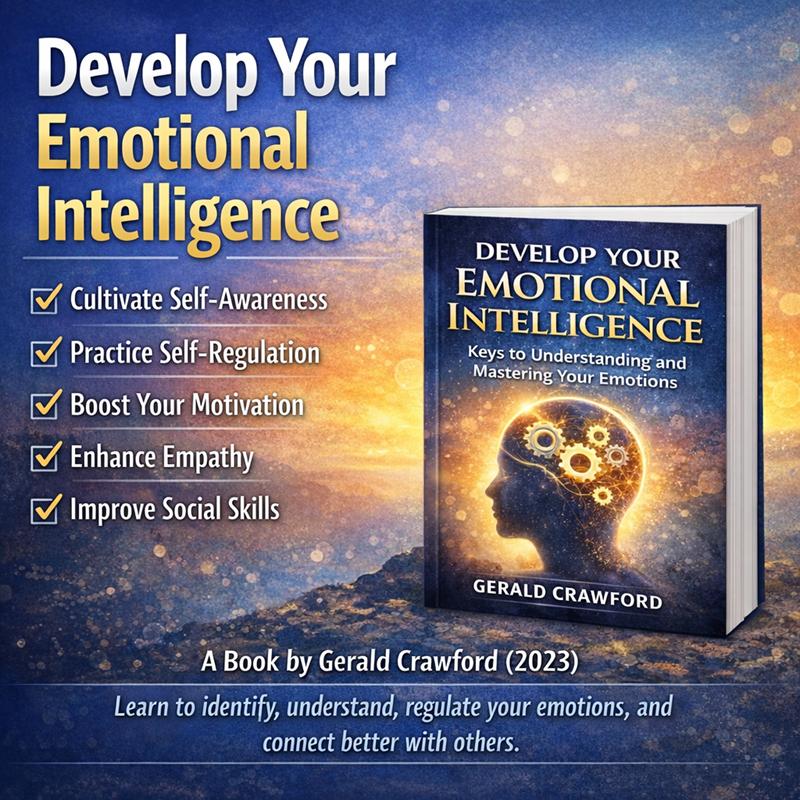
Development your Emotional Intelligence - A Book by Gerald Crawford (2023 Edition)

To develop Emotional Intelligence (EI), cultivate self-awareness by identifying and naming your emotions, self-regulation by managing those feelings, motivation by setting goals, empathy by understanding others' perspectives, and improving social skills through active listening and clear communication.

Page 3 of 46

Understanding your Emotions Better with Hypnotherapy

Below is a word-for-word hypnotherapy script focused on understanding your emotions with clarity, curiosity, and compassion.

It is designed to help emotions feel safe to notice, easy to interpret, and useful rather than overwhelming.


Hypnotherapy Script: Understanding Your Emotions with Clarity

Preparation (spoken slowly and gently):
Find a comfortable position…
Sitting or lying down…
And allow your eyes to close naturally…
Or soften your gaze…

Take a slow breath in through your nose…
And exhale through your mouth…
Letting the body unwind…

Again…
Breathing in calm…
Breathing out tension…

Good.


Induction: Creating Emotional Safety

Notice the surface supporting your body…
Allow yourself to be held…

You don’t need to control anything…
You don’t need to push feelings away…

In this moment…
It is safe to notice what you feel…

As your body relaxes…
Your nervous system settles…
And your mind becomes open and curious…


Deepening: Turning Inward with Awareness

In a moment, I’ll count from five down to one
And with each number…
You drift deeper into calm awareness…

Five… slowing down…
Four… muscles softening…
Three… thoughts becoming quieter…
Two… awareness sharpening…
One… calm… present… receptive…

Good.


Therapeutic Suggestions: Emotions as Information

Now…
Bring your attention inward…
To the space where emotions arise…

Emotions are messages…
Signals from your inner world…

They are not problems to fix…
They are information to understand…

Silently allow this idea to settle:

“My emotions are trying to help me.”

Notice how your body responds…
Perhaps a sense of relief…
Softening…
Openness…

Your subconscious mind begins to release resistance…


Naming and Understanding Feelings

Now imagine an emotion gently coming into awareness…
Not the strongest one…
Just something neutral or familiar…

Notice where it lives in your body…
The chest… the stomach… the throat…

There is no need to judge it…
Simply notice…

Ask gently, without words:

“What are you showing me?”

And allow understanding to arise naturally…
Not logically…
But intuitively…

Your subconscious mind understands emotional language…


Separating Emotion from Identity

You are not your emotions…
You experience them…

They come…
They change…
They pass…

Silently remind yourself:

“I can feel emotions without becoming them.”

And notice how awareness creates space…
Choice…
Freedom…

Your nervous system learns that feeling does not equal danger…


Building Emotional Literacy

From now on…
Each time an emotion arises…
Your subconscious mind responds with curiosity…
Instead of resistance…

You notice…
You name…
You understand…

And the more you understand your emotions…
The less they need to shout…

Clarity replaces confusion…
Calm replaces overwhelm…


Future Pacing: Living with Emotional Insight

Imagine yourself in daily life…
Recognising emotions early…
Understanding what you need…
Responding thoughtfully…

You trust yourself now…
Because you understand your inner signals…

And your subconscious mind accepts this ability as natural…


Emergence

In a moment…
I’ll count from one up to five
And you’ll return feeling calm…
Aware…
And emotionally clear…

One… awareness returning…
Two… breath deepening…
Three… body feeling steady…
Four… mind clear and present…
Five… eyes open when ready… feeling grounded and aware…


Closing Affirmation (optional):

“I understand my emotions with clarity and compassion.
They guide me, not control me.”

Case Study 24: Developing Emotional Intelligence and healing from Fear (100): Anxiety, survival-based, contracted.

Case Study 24: Developing Emotional Intelligence and Healing from Fear

Consciousness Level: Fear (100)
Emotional State: Anxiety, survival-based, contracted


Background

Sipho (35) is capable, intelligent, and cautious — often described by others as “responsible.” Internally, however, his life is governed by anxiety. Every decision is filtered through the question: “What could go wrong?”

Sipho grew up in an unpredictable environment where safety was uncertain and mistakes carried consequences. Over time, his nervous system learned to stay alert. Fear became not just an emotion, but a way of orienting to life.


Emotional Landscape at the Level of Fear

At the Fear level, the core belief is:
“I am not safe.”

Sipho’s emotional world was characterised by:

  • Persistent anxiety and worry

  • Anticipation of loss or danger

  • Mental rehearsal of worst-case scenarios

  • Difficulty relaxing, even in safe conditions

Fear narrowed his attention. The future felt threatening, and the present was rarely experienced fully.


Impact on Relationships

Fear strongly shaped Sipho’s relational patterns:

  • Those He Loved and Cared For:
    He worried excessively about losing them, which led to control or emotional distance.

  • Those He Needed:
    He relied heavily on reassurance, sometimes mistaking safety for dependency.

  • Those He Tolerated or Felt Indifferent To:
    Neutral interactions were interpreted as potential threats or judgments.

Fear distorted perception — ambiguity was experienced as danger.


Behavioural Patterns

Sipho’s behaviour reflected survival orientation:

  • Avoidance of risk and change

  • Over-planning and excessive preparation

  • Difficulty making decisions

  • Tension in the body and shallow breathing

While these behaviours reduced anxiety short-term, they reinforced fear long-term.


The Turning Point: Distinguishing Danger from Discomfort

Sipho’s healing began with a crucial EI insight:

Fear often confuses discomfort with danger.

Through therapy, he learned to ask:

  • “Am I unsafe — or just uncomfortable?”

  • “Is this a real threat or an imagined one?”

This question alone created space between emotion and reaction.


Developing Emotional Intelligence

Sipho developed EI through three foundational skills:


1. Nervous System Awareness

He learned to recognise fear in his body:

  • Tight chest

  • Rapid thoughts

  • Shallow breathing

This shifted fear from an identity to a physiological state.


2. Emotional Regulation

Sipho practiced calming techniques:

  • Slow breathing

  • Grounding in the present

  • Naming fear without acting on it

Regulation reduced fear’s intensity and urgency.


3. Courageous Micro-Actions

Rather than eliminating fear, Sipho practiced acting with fear:

  • Speaking up once

  • Taking small risks

  • Allowing uncertainty

Each action weakened fear’s authority.


Movement Up the Consciousness Scale

Sipho’s growth followed a clear progression:

  • From Fear (100) → awareness and regulation

  • To Desire (125) → motivation and forward movement

  • Toward Courage (200) → empowered action despite uncertainty

Fear softened as confidence grew.


Outcome

Over time, Sipho experienced:

  • Reduced baseline anxiety

  • Increased trust in himself

  • More spontaneous engagement with life

  • Healthier, less controlling relationships

Fear no longer ran his life — it became a signal, not a command.


Key Learning

Fear is not a flaw — it is a protective system that has not yet been updated.
Emotional intelligence teaches us to honour fear without obeying it.

When fear is regulated and understood, it becomes the doorway to courage rather than a barrier to living.

Case Study 23: Developing Emotional Intelligence and healing from Grief (75): Sadness, loss.

Case Study 23: Developing Emotional Intelligence and Healing from Grief

Consciousness Level: Grief (75)
Emotional State: Sadness, loss


Background

Mariam (51) experienced a profound loss within a short period: the death of her mother, followed by the end of a long-standing marriage. While she continued to function in daily life, an undercurrent of sadness coloured everything. Her grief was not chaotic or dramatic — it was persistent, quietly reshaping how she saw the world.

Unlike apathy, Mariam still felt deeply. Her pain was a sign that something meaningful had been lost — but she did not yet know how to integrate that loss.


Emotional Landscape at the Level of Grief

At the Grief level, the core belief is:
“Something important is gone, and I don’t know how to live without it.”

Mariam’s emotional experience included:

  • Deep sadness and longing

  • Waves of nostalgia and regret

  • Tearfulness triggered by memories

  • Difficulty imagining a meaningful future

Grief contains more energy than apathy — but that energy is directed backward.


Impact on Relationships

Grief reshaped Mariam’s relationships in complex ways:

  • Those She Loved and Cared For:
    She sought comfort but also withdrew, fearing she was a burden.

  • Those She Needed:
    She relied heavily on a small circle, sometimes feeling guilty for needing support.

  • Those She Tolerated or Felt Indifferent To:
    Neutral interactions felt hollow and effortful.

Grief narrowed her relational world — depth increased, breadth decreased.


Behavioural Patterns

Mariam’s behaviours reflected mourning and emotional processing:

  • Replaying memories

  • Avoiding new commitments

  • Reduced interest in future planning

  • Clinging to familiar routines

These behaviours were not dysfunctional — they were part of emotional digestion.


The Turning Point: Allowing Grief Without Collapse

Healing began when Mariam stopped trying to “move on” and instead learned to stay present with grief without being consumed by it.

A pivotal insight emerged:

Grief does not need to be fixed — it needs to be felt.

This marked a shift from resistance to emotional acceptance.


Developing Emotional Intelligence

Mariam strengthened EI through three key capacities:


1. Emotional Allowance

She practiced letting sadness rise and fall without judgment:

  • Crying without shame

  • Speaking openly about loss

  • Naming emotions as they appeared

This prevented grief from becoming frozen or suppressed.


2. Meaning-Making

Mariam began asking:

  • “What did this loss teach me?”

  • “How has love shaped who I am?”

This reframed grief as evidence of connection rather than failure.


3. Gradual Reorientation

She gently reintroduced forward-looking actions:

  • Small plans

  • New interests

  • Social engagements without pressure

The future was approached softly, not forced.


Movement Up the Consciousness Scale

Mariam’s healing followed a natural arc:

  • From Grief (75) → emotional expression

  • To Fear (100) → uncertainty about the future

  • Toward Courage (200) → choosing engagement despite pain

Grief did not disappear — it transformed.


Outcome

Over time, Mariam experienced:

  • A softer relationship with loss

  • Renewed emotional depth without overwhelm

  • Increased openness to new meaning

  • Stronger emotional authenticity

Her grief became integrated, not erased.


Key Learning

Grief is not weakness — it is the cost of love.
When met with emotional intelligence, grief becomes a bridge between loss and growth.

Healing does not mean forgetting.
It means carrying love forward in a new form.

Nervous System Healing – Visualize the FOREST that grounds, balances, connect, stabilizes

Nervous System Healing – The Forest Visualization

Allow your body to settle.
Feel the support beneath you.
Inhale slowly…
exhale fully…
letting your weight drop into the moment.

There is nothing to chase here.
The forest is already holding you.


Visualize the Forest.

See yourself standing among tall, steady trees.
Their trunks are strong.
Their roots run deep.
The air is cool, clean, and alive.

This forest has stood through storms,
through seasons,
through change.

So can you.


Grounding
Imagine roots growing gently from the soles of your feet,
sinking into the earth below.
They connect you to the soil, the stone, the ancient stability beneath life.

Your nervous system slows.
Safety replaces urgency.
Your body knows where it belongs.


Balancing
Dappled light filters through the leaves above you.
Not too bright.
Not too dark.

Your inner systems adjust naturally—
breath, heart, thoughts, emotions—
finding their own equilibrium.

Nothing is forced.
Balance happens on its own.


Connecting
Feel the quiet presence of the forest around you.
You are not alone here.
Every tree, every sound, every breath is part of a larger whole.

Your nervous system relaxes
as connection replaces isolation.

You are included.
You always have been.


Stabilizing
Now rest your back against a tree.
Feel its solidity.
Its patience.

Any inner shaking settles.
Any emotional sway becomes still.
The forest lends you its steadiness.

Your nervous system becomes anchored,
regulated, and calm.


Silently affirm:
“I am grounded and supported.”
“I am connected and safe.”
“My nervous system is stable and balanced.”


Stay here for a few breaths,
listening to the leaves,
the birds,
the quiet wisdom of nature.

When you are ready,
take a slow, full breath…
feel your body again…
and gently open your eyes,
bringing the forest’s calm strength with you.

Nervous System Healing – Visualize the OCEAN that cleanses, refreshers, invigorate, releases

Nervous System Healing – The Ocean Visualization

Settle your body.
Let gravity hold you.
Breathe in slowly through the nose…
and sigh it out through the mouth.

Nothing to fix.
Nothing to manage.
Just arrive.


Visualize the Ocean.

See an endless body of water before you—
vast, rhythmic, alive.
The ocean is powerful,
yet it never rushes.

Its waves move with certainty.
Your nervous system remembers this rhythm.


Cleansing
As the water reaches your feet,
it gently washes away accumulated tension.
Stress dissolves into the saltwater.
Old emotional residue loosens and floats free.

The ocean accepts everything
without judgment or effort.


Refreshing
Cool, clean water rises to your calves… your knees…
bringing relief and renewal.
Your breath feels lighter.
Your thoughts slow.

Every wave leaves you clearer than before.


Invigorating
Feel the vitality of the ocean moving through you.
Not sharp energy—
but deep, steady aliveness.

Your circulation awakens.
Your muscles soften while your life force strengthens.
Your nervous system shifts from depletion
into natural, grounded energy.


Releasing
Now the waves move in and out around your body.
With each outward wave,
something unnecessary leaves you.

Holding… gone.
Hypervigilance… gone.
Emotional weight… released.

The ocean knows how to carry it away.


Silently affirm:
“I release what I no longer need.”
“My nervous system resets naturally.”
“I trust the rhythm of life.”


Remain here for a few breaths,
listening to the waves…
letting their timing guide your own.

When you’re ready,
feel the ground beneath you again…
take one deeper breath…
and gently open your eyes,
bringing this calm, refreshed state with you.

« Older posts Newer posts »
Back a Buddy Show your Support