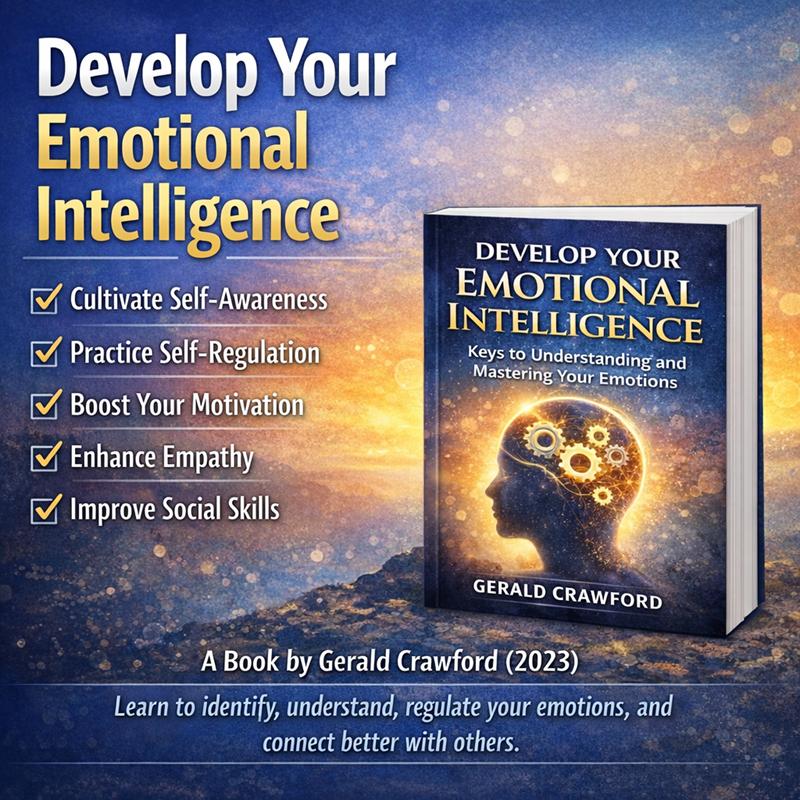
Here’s a detailed, structured explanation of the Emotional Intelligence Therapy and Healing Model (EI Model) as presented in Developing Your Emotional Intelligence by Gerald Crawford (2023). You can use this for chapter content, training materials, therapy guides, or educational pages.
Detailed Definitions of the Emotional Intelligence Therapy and Healing Model (EI Model)
The Emotional Intelligence Therapy and Healing Model (EI Model) provides a practical framework for developing emotional wellbeing, resilience, and relational competence. It breaks emotional intelligence into five core domains: Self-Awareness, Self-Regulation, Motivation, Empathy, and Social Skills. Together, these build a foundation for emotional health, effective communication, and deep personal growth.
Self-Awareness
Definition:
The ability to recognise, identify, and understand your own emotions as they occur.
Key Components:
- Emotion Identification: Naming what you feel (e.g., sadness, anxiety, joy, frustration)
- Emotional Insight: Understanding why a feeling has arisen
- Emotional Patterns: Recognising recurring emotional triggers and habits
Therapeutic Importance:
Self-awareness is the starting point for emotional healing. Without it, emotions remain vague sensations that unconsciously influence behaviour. Developing self-awareness gives clarity and choice, rather than confusion and reaction.
Applications:
- Journaling feelings
- Mindfulness and somatic awareness
- Reflective questioning (“What am I feeling right now?”)
Self-Regulation
Definition:
The capacity to manage, control, or appropriately express emotions rather than being controlled by them.
Key Components:
- Impulse Control: Choosing responses instead of reacting
- Emotional Modulation: Reducing reactivity during intense emotions
- Adaptive Coping: Using healthy strategies (breathing, reframing, pausing)
Therapeutic Importance:
Self-regulation supports emotional stability. When individuals can regulate internal states, they experience less emotional overwhelm, better decision-making, and stronger resilience to stress.
Applications:
- Breath work and grounding techniques
- Pause and reflective response strategies
- Cognitive reframing of emotional meaning
Motivation
Definition:
The ability to harness emotions to facilitate goal orientation, persistence, and self-directed growth.
Key Components:
- Purposeful Drive: Acting in alignment with deeper values
- Emotional Incentive: Using positive feelings like hope and fulfillment to sustain efforts
- Goal Clarity: Emotional anchoring of personal intentions
Therapeutic Importance:
Motivation links emotion and action. It fosters optimism, commitment, and endurance. Emotional intelligence enhances motivation by helping individuals translate inner emotional energy into constructive, sustained effort.
Applications:
- Setting value-aligned goals
- Celebrating emotional wins
- Ambition grounded in personal meaning
Empathy
Definition:
The ability to recognise, understand, and resonate with the emotional experiences of others.
Key Components:
- Emotional Recognition: Observing emotional cues (tone, expression, body language)
- Perspective Taking: Understanding another’s emotional context
- Compassionate Resonance: Feeling with others without losing self-boundaries
Therapeutic Importance:
Empathy bridges inner emotional life with interpersonal connection. It enables deeper bonds, reduces conflict, and enhances trust. In therapy and healing, empathy is both a skill and a relational space for shared understanding.
Applications:
- Reflective listening
- Nonjudgmental presence
- “Feeling with” rather than “feeling for”
Social Skills
Definition:
The skills used to communicate, connect, negotiate, and engage with others effectively and authentically.
Key Components:
- Active Listening: Fully attending to another’s communication
- Clear Expression: Sharing thoughts and feelings directly and respectfully
- Conflict Resolution: Navigating disagreements constructively
- Relational Awareness: Adapting communication to emotional context
Therapeutic Importance:
Social skills translate emotional intelligence into interpersonal effectiveness. They allow individuals to build relationships, set healthy boundaries, and participate in meaningful exchanges without miscommunication or emotional sabotage.
Applications:
- Assertive communication training
- Reflect-and-respond methods
- Emotional attunement in dialogue
Why the EI Model Matters
The EI Model is not simply a theoretical concept; it is a practical therapeutic and healing approach that:
- Integrates emotional awareness with behavioural change
- Builds resilience against emotional dysregulation
- Enhances interpersonal connection and support
- Promotes ongoing personal growth and self-mastery
Learn More
Discover tools, exercises, and deeper explanations at: https://emotional-intelligence.co.za/.




Recent Comments